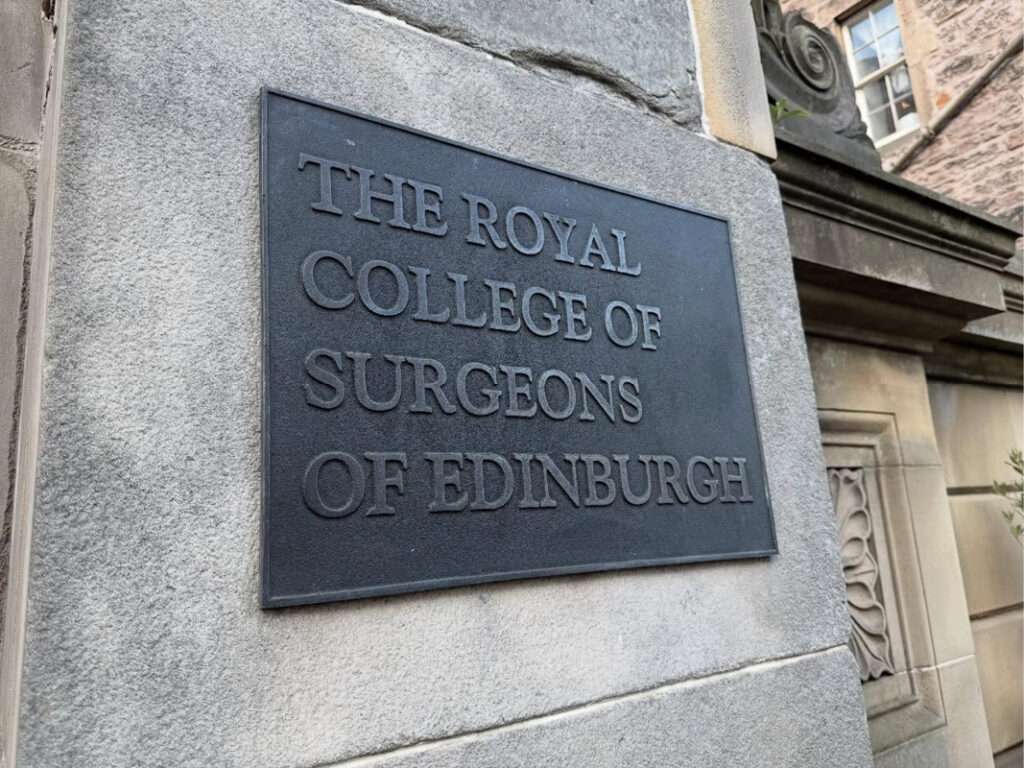
Transorbital Course Highlights – The Royal College of Surgeons of Edinburgh

Aug
Shahz Ahmed, the 2nd Transorbital Course director, works on the Anatomex3D Transorbital Surgical Simulation model
Transorbital course highlights – Anatomex3D Transorbital Model unveiled at The Royal College of Surgeons of Edinburgh (RCSEd) 2025
On 24 May 2025, the historic halls of The Royal College of Surgeons of Edinburgh (RCSEd) became a hub of innovation in transorbital surgery. These transorbital course highlights capture the energy, innovation, and global expertise that shaped the event. Under the expert direction of Mr Shahz Ahmed, Consultant Rhinologist & Skull Base Surgeon and Medical Director at University Hospitals Birmingham, the 2nd Transorbital Surgery Course brought together a distinguished international faculty and enthusiastic delegates to explore one of the most exciting frontiers in minimally invasive skull base and orbital surgery.
The faculty lineup reflected the multidisciplinary nature of this field, with Prof. Darlene Lubbe (South Africa), a global leader in endoscopic and transorbital approaches; UK oculoplastic expertise from Mr Austin McCormick (Liverpool) and Reena Kumari (Birmingham); and rhinology perspectives from Mr Karan Jolly (Birmingham). Their combined experience created a dynamic learning environment for delegates seeking to advance their skills in this emerging technique.
Innovation meets hands-on training
The course combined didactic lectures, dry lab simulations, and cadaveric dissections—moving participants from theoretical understanding to practical surgical mastery. Among the key transorbital course highlights was the debut of the Anatomex Transorbital 3D Surgical Simulation Model, which bridged the gap between textbook anatomy and surgical reality.
While cadaveric dissection remains invaluable for tactile skill development, it has limitations: anatomical anomalies are rare, and pathological scenarios are absent. Anatomex3D’s high-fidelity surgical models address these gaps, enabling faculty to demonstrate complex anatomy, simulate pathology, and practise surgical pathways that cadaver specimens cannot reliably offer.
Visualising the lateral superior eyelid approach
One of the most challenging concepts for surgeons new to transorbital techniques is accessing the laterally pneumatised sphenoid sinus via a lateral superior eyelid approach. With the Anatomex3D model, faculty were able to illustrate this pathway clearly, showing how this minimally invasive route can offer access to lateral skull base pathology. Delegates then practised on the models using powered instruments and navigation systems, gaining hands-on familiarity in a risk-free setting.
This simulation experience proved particularly valuable for understanding the spatial relationships of the orbit, frontal sinus, and lateral sphenoid. As one delegate commented, “The 3D models made the anatomy come alive in a way I’ve never seen in a cadaver lab. It’s an ideal bridge before transitioning to live surgery.”
Why 3D simulation is changing surgical training
The success of this course underscored a growing recognition of the role 3D printed surgical simulation plays in training the next generation of skull base surgeons. Anatomex3D’s models offer:
- Reproducibility: Every model contains consistent and challenging anatomy, unlike cadaver specimens.
- Pathology Representation: Simulated lesions and variations allow surgeons to plan and rehearse complex cases.
- Safe Skill Acquisition: Trainees can repeat steps, experiment with approaches, and refine technique without concern for tissue loss.
As transorbital approaches gain traction worldwide, the ability to train on high-fidelity models is becoming essential for developing competence and confidence.
A vision for the future
The 2nd Transorbital Surgery Course at RCSEd was more than just a training event—it was a forward-looking example of how multidisciplinary collaboration, advanced simulation, and expert mentorship can transform surgical education. These transorbital course highlights mark a new standard for surgical training, offering ENT, oculoplastic, and neurosurgeons the chance to expand their expertise and elevate patient care through innovative tools like the Anatomex Transorbital 3D Model.
For ENT and oculoplastic surgeons eager to expand their repertoire, the Anatomex Transorbital 3D Model is not just a teaching tool—it’s an opportunity to explore, innovate and elevate patient care.
“The 3D models made the anatomy come alive in a way I’ve never seen in a cadaver lab. It’s an ideal bridge before transitioning to live surgery.” – Shahz Ahmed