
 Transorbital Surgery Book
Anatomex 3D at Sydney’s Endoscopic Orbital and Skull Base Workshop 2025

Endoscopic Orbital and Skullbase Workshop 2025 Showcases Next-Gen Surgical Simulation in Sydney
On 26–27 March 2025, history was made in Sydney. For the first time ever, Australia hosted an International Endoscopic Skull Base and Orbital Tumour Dissection Workshop, setting a new benchmark for surgical training in the region.
The Endoscopic Orbital and Skullbase Workshop 2025, masterfully organised by Dr Catherine Banks, one of Australia’s leading rhinologists, in collaboration with Dr Ben Bleier (Harvard Medical School), brought together an extraordinary faculty of international and Australian experts across ENT, neurosurgery, and oculoplastics. Held just days before the ASOHNS Annual Scientific Meeting—celebrating 75 years of excellence—it marked a week of innovation for the surgical community.
Two Days. Three Specialties. Infinite Insights.
The workshop offered a rich combination of didactic lectures, live discussions, and cadaveric dissections, designed to push boundaries and promote cross-disciplinary collaboration. With world-class faculty leading the way, delegates explored cutting-edge techniques in endoscopic orbital and skull base surgery.
The guest faculty featured a world-class lineup: Dr Catherine Banks, Dr Ben Bleier, Dr Darlene Lubbe, Dr David Gudis, Dr Agnieszka Strzembosz, Dr Bradford Woodworth, Dr Raymond Sacks, Dr Alkis Psaltis, Dr Raewyn Campbell, Dr Richard Harvey, Dr Chris Dhepnorrarat, Dr Eng Ooi, Dr Dinesh Selva, Dr Geoff Wilcsek, Dr Krishna Tumuluri, Dr Edwin Figueira, Dr Jacob Fairhall, Dr Raj Reddy, and Dr Peter Wilson. Their collective expertise offered delegates unique insights spanning ENT, oculoplastics, and neurosurgery.
Photo: Dr Catherine Banks (left) and Dr Darlene Lubbe (right) with the Anatomex3D Transorbital Surgical Model

For many participants, it was their first chance to work alongside such a diverse, high-calibre group—mirroring the collaborative environment of real-world practice.
And in another Australian first, Medtronic provided each workstation with its own Stealth Image Guidance system, allowing for precise anatomy visualisation and trajectory planning. Complex endoscopic procedures demand this level of technological support, and delegates experienced first-hand how navigation transforms surgical confidence.
Enter Anatomex3D: A World-First Simulation Model

The Endoscopic Orbital and Skullbase Workshop 2025 also broke new ground with the introduction of the Anatomex3D Transorbital Surgical Simulation Model — the first time such a model has been used in any workshop globally.
This 3D-printed model captivated delegates with its unprecedented anatomical fidelity and realistic surgical feel. Highlights included:
- Bone drilling feedback that mirrored live surgery.
- Soft tissue planes, from skin and orbicularis oculi to periosteum, enabling authentic subperiosteal dissection.
- Key landmarks, such as the recurrent branch of the middle meningeal artery leading to the superior orbital fissure.
- Intracranial detail, including dura, cavernous sinus, V1–V3, and the ICA—all perfectly positioned.
Photo: Dr Geoff Wilcsek with the Anatomex3D Surgical Simulation Model
This allowed participants to visualise and rehearse complex approaches before transitioning to cadaveric dissections. As one delegate noted, “The 3D model let us refine our skills and understand the anatomy on a level cadavers alone can’t offer.”
The feedback from attendees was overwhelmingly positive, with many praising the balance between innovation and practical relevance. Several delegates commented on how the integration of simulation and navigation technology enhanced their anatomical understanding and surgical decision-making. Faculty members, too, acknowledged the value of combining 3D simulation with cadaveric training — a hybrid model that may well become the gold standard for future surgical education.
The Endoscopic Orbital and Skullbase Workshop 2025 has set a new benchmark not only for Australia but for global training standards, demonstrating what’s possible when technology, talent, and vision come together in one room.
“The 3D model lets us refine our skills and understand the anatomy on a level cadavers alone can’t offer.”
A Glimpse into the Future of Surgical Education
While cadaver labs remain vital, they have limits—anatomical anomalies are rare, and pathology is absent. The Anatomex3D model fills this gap by providing consistent, pathology-representative, and highly realistic training scenarios.
A Milestone Moment
This landmark 2025 workshop in Sydney wasn’t just another surgical course—it was a vision of where surgical education is headed. With Dr Catherine Banks’ inspiring leadership, a stellar international faculty, cutting-edge navigation technology, and the Anatomex3D model, delegates left better prepared to tackle complex orbital and skull base cases with confidence.
The future of surgical training has arrived, and it’s 3D.
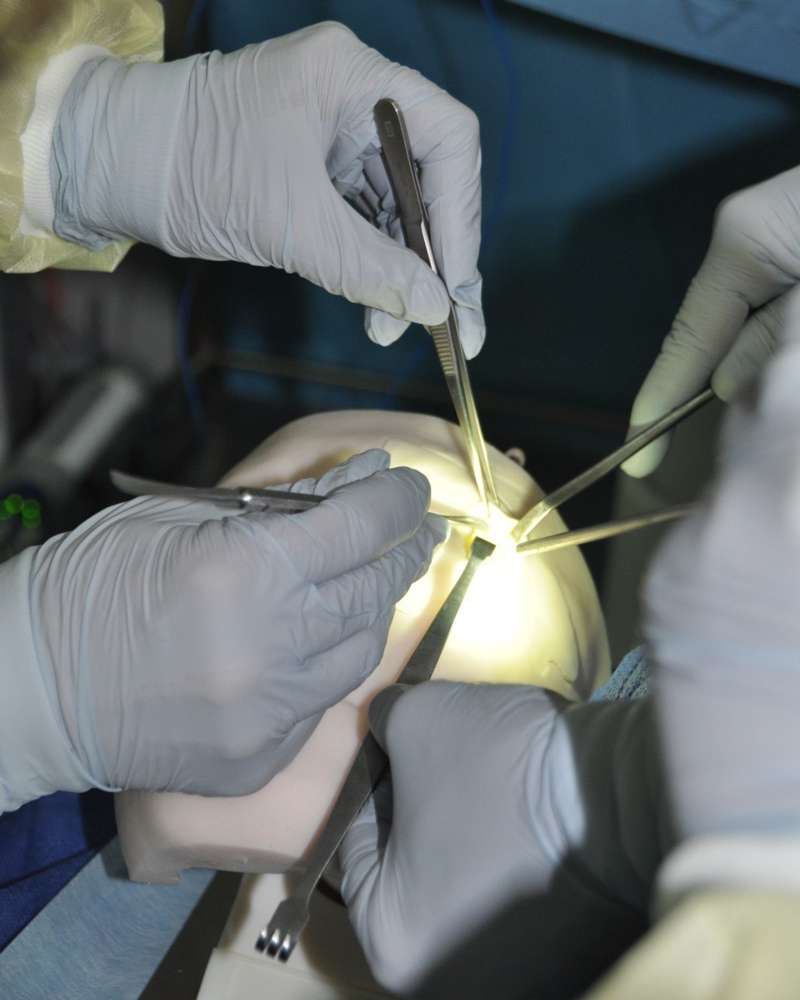
Main photo top: Dr Geoff Wilcsek (Oculoplastic surgeon – Department of Ophthalmology, Prince of Wales and Sydney Children’s Hospitals and Dr Agnieszka Strzembosz (International Medical Affairs Director, Medtronic ENT) test drive the Anatomex3D Transorbital Surgical Simulation Model at the Workshop.